Shared web hosting or dedicated web hosting, it doesn't make a difference. Whatever gets you online, right? Not necessarily...
While both types of web hosting give you more or less the same result, they take different routes to get there. Depending on the needs of your website, your business or your online presence in general, you may prefer one or the other.
So, before committing to either one, it's important that you know what each of them offers, where they fall short and what to expect from each type of server.
These are, of course, not the only two hosting options available. Think of them as opposite ends of the hosting spectrum (and neither end of the spectrum is good or bad).
There are many ways to use a server for hosting, but in this blog we'll focus only on shared web hosting and dedicated web hosting.
What's the difference between shared hosting and dedicated hosting?
As we said, the result is the same but the paths to get there are slightly different. Both types of hosting give your website and web data a home.
The difference is that with shared hosting you have access to part of a server. This means you have neighbouring websites on the same server, all using the server's resources.
A dedicated server is just that: a server that is dedicated to you alone. Dedicated servers are also called bare-metal servers. With a dedicated server you have no neighbours on the same machine, and all its resources are yours alone.
Think of it like living in an apartment block (shared web hosting) versus living in your own house (dedicated web hosting). Again, there are slight differences, but the result is mostly the same. Let's go into a little more detail about each and the hosting experience they provide. If you're new to hosting, start with our guide on what web hosting is.
What is shared web hosting?
With shared hosting, your website is housed on a server that is shared with other websites. That can run into the thousands, depending on the server. Not only is the physical space on the server shared, but the server's other resources are as well.
This also means that the standards, protocols and resources the server uses are the same for everyone. There's not much wiggle room in shared hosting.
Pros and cons of shared web hosting
Both web hosting arrangements have their pros and cons. Depending on your situation, each person will weigh them differently. Let's take a look at the pros and cons of shared web hosting.
Pros of shared web hosting
- Low cost
- Little to no server administration on your part
- Easy to set up and manage websites
- Free extras
- Expert support
The main reason to choose shared hosting is cost. It costs far less than a dedicated server, which suits a budding business, or anyone who just wants to get a blog up and running.
You'll also need very little technical skill to set things up. You can take care of your own website through your control panel, and you'll get prompts for updates and patches that you simply have to install. HostAfrica shared hosting uses the DirectAdmin control panel.
The hosting provider carries out server maintenance, so you don't have to worry about the wellbeing of the hardware.
Some hosting providers include free extras with shared hosting. Every HostAfrica Web Hosting plan includes free Let's Encrypt SSL and a free .africa domain when it's the primary domain for the hosting account. The domain renews each year at the normal price.
Alongside these extras is an excellent support team. Again, we can only speak for ourselves here, but having dedicated expert support helps tremendously. As a shared hosting client, you'll have less to worry about when you face problems.
Cons of shared web hosting
- Sharing resources
- Less flexibility for customisation
- Higher security risks
- No admin rights
Sharing resources would be fine in a perfect world, but some websites demand more resources than others. This means your website may suffer because of a noisy neighbour hogging resources.
Hosting companies should keep a reasonable number of tenants on each server so it doesn't get overloaded.
Being on the same server also means that none of the tenants have admin rights. It would be chaos if everyone changed the server's settings to suit themselves all the time. To prevent this, shared hosting means you can't make changes to the server or customise it in any way.
This means you'll have to ask your hosting provider to help with any admin tasks.
Being on a shared server also increases your security risk. You can't account for the safety and security habits of everyone on your shared server.
So, if someone sends spam or gets hacked, your website and data could be at risk as well. While that may be the case with some providers, we protect our users with caged environments. HostAfrica isolates each shared hosting account with CageFS, so a hacked account can't affect another client.
We have strict abuse and security policies in place, and we monitor our systems around the clock for any issues. But nothing is 100% safe all the time.
Who is shared hosting for?
Shared web hosting is ideal for anyone who needs a basic website. Its low cost makes it viable for most people, and it should be the starting point for almost everyone creating a new website.
Most of the disadvantages can be ignored if the hosting company is reputable and takes care of things.
What is dedicated web hosting?
Dedicated web hosting is having a server that is dedicated to you alone. That means all the resources are yours to use as you see fit.
While you enjoy admin rights and unshared resources, you'll also get a hefty price tag attached to them.
Pros and cons of dedicated web hosting
As with everything, the pros and cons of dedicated web hosting depend on the user. Higher costs may put some people off, but they won't make much difference to others. Let's take a look at what we consider the pros and cons of dedicated web hosting.
Advantages of dedicated web hosting
- Full root access (admin rights)
- Full use of resources
- Customisable
- Full control over security
One of the major points in favour of dedicated servers is that all the resources are allocated to you. That means processing power, memory, disk space and bandwidth are all yours to use.
You can also customise your server to your liking, because you'll have root access. That means choosing the operating system you want to use and adding any software you want.
While you won't have to worry about other people causing security issues, you will have to take care of security yourself. That means you'll need to set up your own security measures and firewall.
Make your server as secure as you can. With strong security in place and kept up to date, your server is much harder to break into.
Disadvantages of dedicated web hosting
- Pricey
- Technical knowledge required
- Maintenance responsibility
The first drawback of this type of web hosting is the cost. It's one of the most expensive options in hosting. That rules it out for most people right away, as it's not a viable solution for the projects they have in mind. All those resources do not come cheap.
Another disadvantage is the technical knowledge you need to maintain and run a dedicated server. While you won't need to handle the hardware or the network, everything else becomes your responsibility.
If you don't know how to set up or maintain a server, you could hire a systems administrator, at an extra cost. Security updates and patches also fall on your shoulders. With great web hosting power comes great web hosting responsibility.
Who is dedicated hosting for?
Dedicated servers are for companies that get very high traffic and need more resources. They also suit companies or institutions that need an extra layer of security.
Dedicated servers are best suited to those with technical know-how, or those who can afford to pay someone else to manage them.
Shared web hosting versus dedicated web hosting
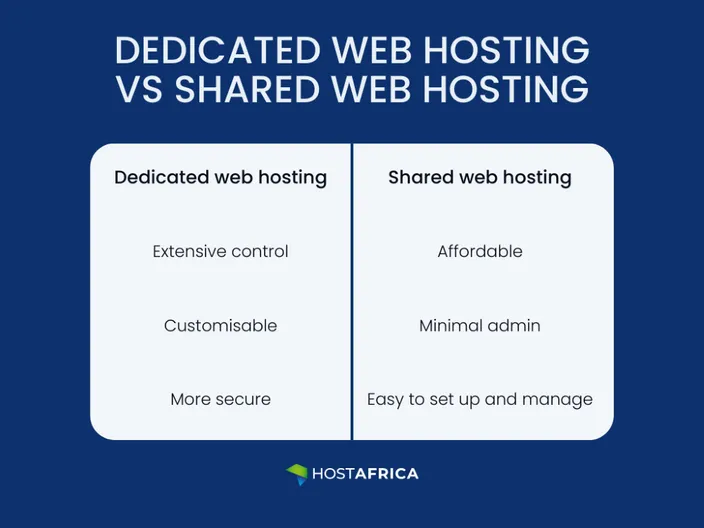
As you've now discovered, both dedicated and shared hosting have their advantages and disadvantages. Both are viable choices, depending on your needs and goals.
If you have a small business or project that needs minimal resources, shared hosting is perfect for you. If you have a big business that gets plenty of traffic and needs more resources, a dedicated server is the better choice.
Whichever option you choose, your hosting provider plays a crucial role in your website's success. HostAfrica runs shared hosting in data centres in South Africa, Kenya, Nigeria and Ghana, and dedicated servers in South Africa. Compare the current plans and prices on our web hosting and dedicated servers pages.